Fractal Gait Variability: Why It Matters and How to Train It
The way you walk is one of the clearest signs of how adaptive your body is. A healthy stride is never perfectly regular: every step is slightly longer or shorter than the last, and those small differences are organised fractally — short-term fluctuations stay in conversation with long-term ones. That fractal variability weakens with age, fatigue and neurological disease, and in older adults a lower value goes together with recent falls. It is one of the best-studied markers of health in movement science.
What fractal walking looks like, played at walking pace: the footprints light up as each step lands, and the chart adds one stride interval at a time. The 128 intervals have a DFA alpha of 0.99. The series is generated, not recorded, with the range of a typical walking stride.
It can also be trained, and this is what SelfSense is built for. The app gives you direct, real-time feedback on the fractal variability of your movement, in two ways:
- Feedback on your gait. Gait mode detects every step, measures the intervals between them and shows whether your stride is rigid, adaptive or random while you walk or run.
- Feedback on your movement. Movement mode does the same on your overall motion, so it also works for standing, postural work and any practice where there are no steps to count.
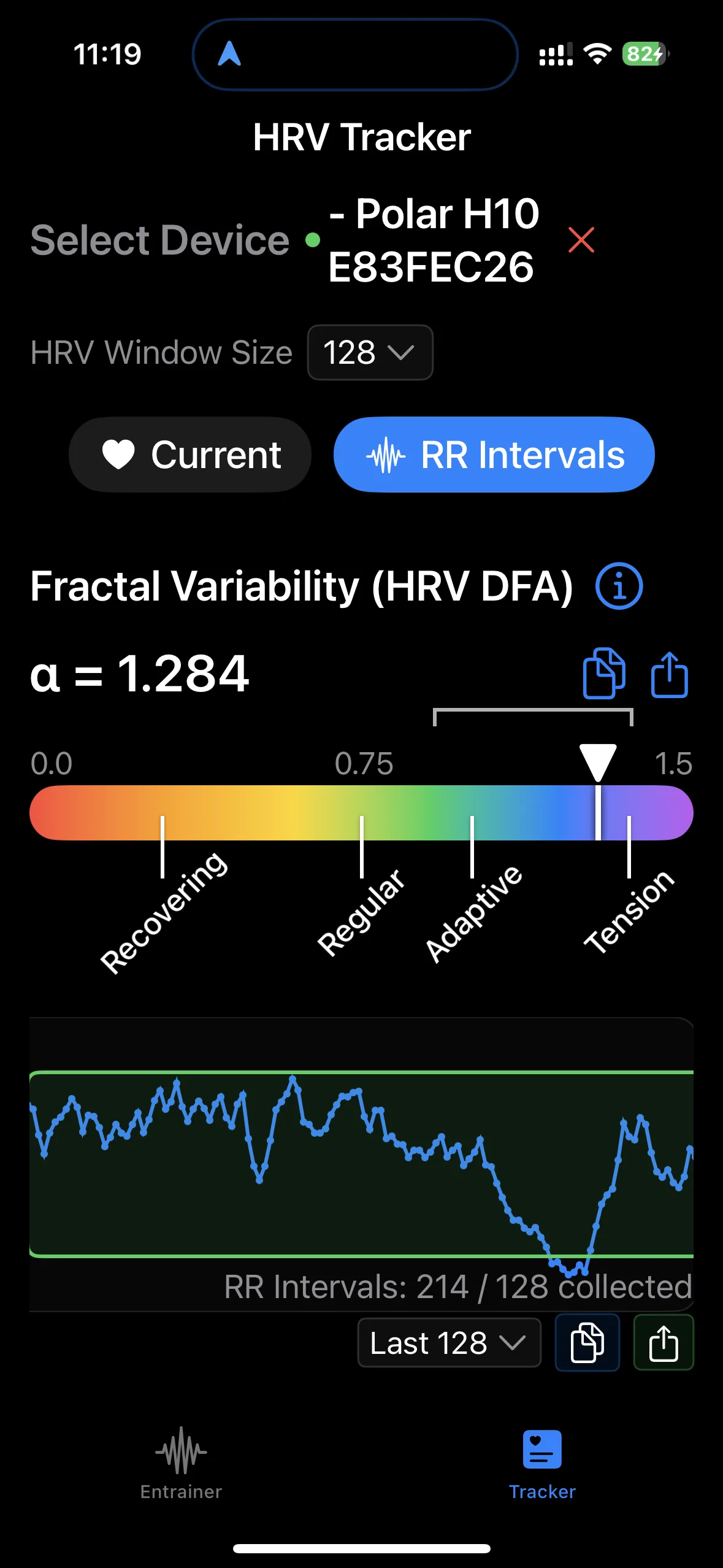
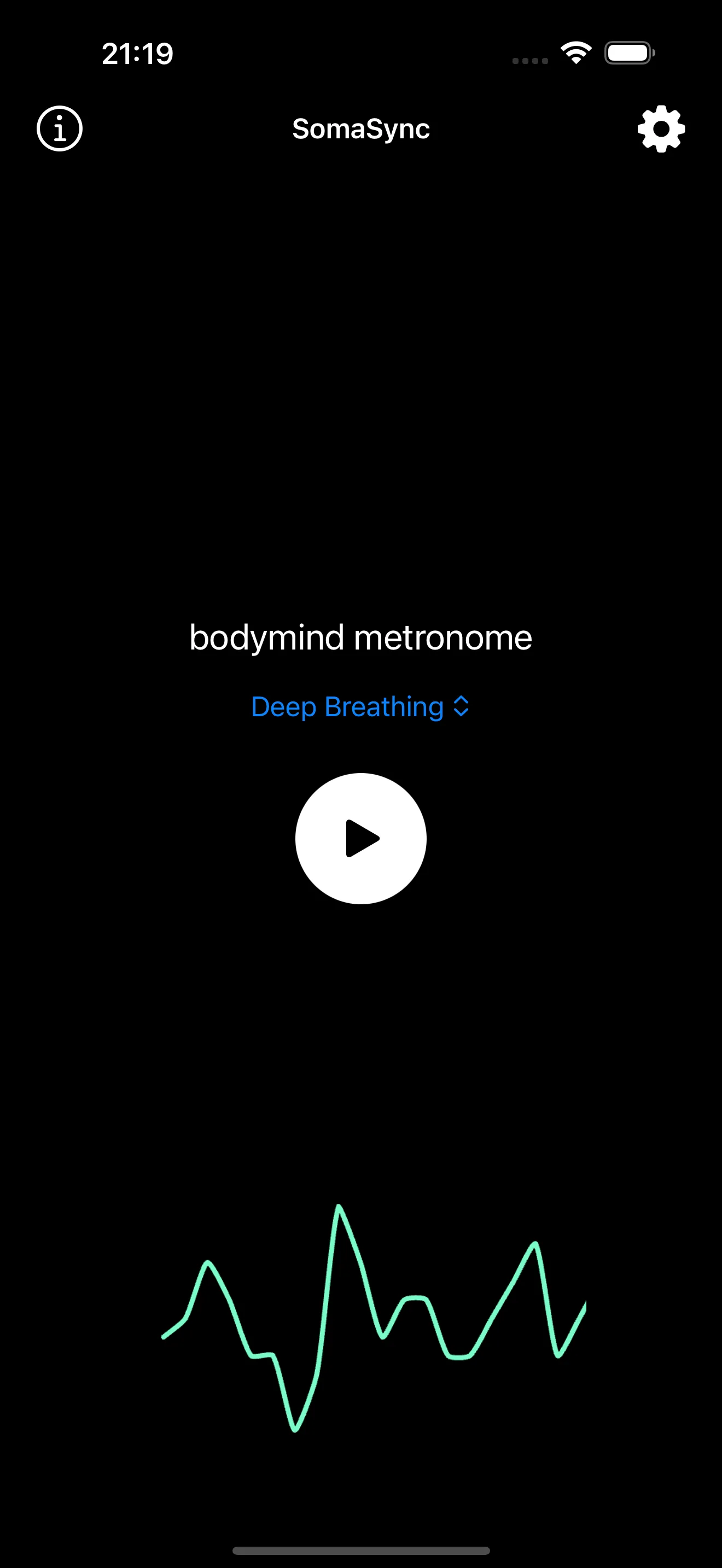
The fractal variability meter, which places your alpha on a scale from recovering through regular and adaptive to tension, and the bodymind metronome that generates a fractal rhythm to move and breathe with.
In both modes you see your DFA alpha1 on iPhone or on your wrist as you move, so you can feel what changes it — pace, attention, breath, tension — and learn to find your adaptive sweet spot (α₁ ≈ 1.0). The fractal-rhythm metronome adds a second tool: a variable rhythm to move with, instead of the fixed beat that gait research shows will flatten your stride.
This page covers the research, how to practise with SelfSense, and the limits you should know about. The SelfSense app is a free beta for iPhone and Apple Watch. It has no medical clearance and is not a treatment for any condition.
Why Fractal Gait Variability Matters for Health
Stride intervals look steady, but they are not. Hausdorff et al. (1995) found that the small differences from one stride to the next are not random: they are correlated over long stretches of time, so a slightly long stride is statistically linked to strides hundreds of steps later. A year later the same group showed that these long-range correlations stay stable across slow, normal and fast walking (Hausdorff et al., 1996).
This structure is measured with Detrended Fluctuation Analysis (DFA), which produces a scaling exponent, alpha. Values near 1.0 mean the signal is fractal — it has memory across time scales. Values near 0.5 mean the intervals are uncorrelated, like white noise. It is the same measure SelfSense applies to your heart rate and to your movement.
The fractal structure of gait weakens when the system that produces it loses coordination:
Redrawn from the values reported by Hausdorff et al. (1997). The closer alpha falls toward 0.5, the more random the stride-to-stride fluctuations become.
- Aging. In Hausdorff et al. (1997), alpha was 0.87 ± 0.15 in young adults and 0.68 ± 0.14 in older adults.
- Neurological disease. In the same study, alpha was 0.60 ± 0.24 in people with Huntington's disease against 0.88 ± 0.17 in healthy controls, and the lower it was, the greater the functional impairment. Ravi et al. (2020) pooled 14 studies and concluded that both aging and Parkinson's disease reduce the long-range correlations of gait.
- Falls. In 60 community-dwelling older adults, a DFA scaling exponent computed from lumbar and foot accelerometers was significantly lower in those who reported recent falls (Terrier & Piergiovanni, 2026).
- Fatigue. In fatigued running, stride-time fluctuations became more persistent and more tightly coupled to muscle activity, which the authors read as a less flexible locomotor system (Chalitsios et al., 2026).
The conclusion is not that more variability is better. Stergiou and Decker (2011) describe an optimal variability: movement that is too rigid is brittle, movement that is too random is uncoordinated, and healthy movement lives in-between. This is the same principle we describe as adaptive variability — a body whose scales stay in conversation can absorb a stumble, a change of pace or a new demand on balance without losing the overall pattern.
What a Fixed Metronome Does to Your Stride
Walking or running to a fixed beat is the usual way to set a cadence. It has a cost. In the same 1996 study, Hausdorff et al. asked people to walk in time with a metronome, and the stride-interval series became uncorrelated. The walking looked more regular, but the fractal structure was gone.
An illustration of the Hausdorff et al. (1996) finding with generated series: stride intervals with a DFA alpha of 0.99 (top) and 0.51 (bottom), drawn on the same scale and at walking pace. These are not the study's recordings.
Marmelat et al. (2014) tested this directly. Participants walked to either an isochronous (fixed) metronome or a fractal one, whose inter-beat intervals had a pink-noise structure. The fractal metronome restored persistent stride fluctuations. The fixed one did not.
We make the same argument about breathing for HRV: a single imposed rhythm can make the numbers look tidy while it simplifies the system. A body that follows one cadence learns to be regular. It does not learn to be adaptive.
What Happens When the Rhythm Is Fractal
A fractal rhythm keeps the same average tempo as a fixed one, but the time between beats keeps changing, and the changes are organised across scales:
A fixed beat against a fractal one, at real tempo. Turn on the sound to hear each rhythm. The fractal intervals are generated with a DFA alpha of 0.99.
Several studies since then point the same way — the stride takes on the structure of the rhythm it follows:
- Coloured-noise music. Hunt, McGrath and Stergiou (2014) cued walking with music whose timing followed white, pink or brown noise. Stride alpha was 0.75 with white noise, 0.89 with pink and 0.94 with brown.
- Visual cues in older adults. Vaz, Knarr and Stergiou (2020) had older adults walk to a fractal-like visual stimulus. Their scaling exponent rose by about 20%, and the change persisted after the cue stopped.
- Interactive cueing in Parkinson's disease. Hove et al. (2012) used Walk-Mate, a system that adjusts its beat to the walker. In people with Parkinson's, alpha went from 0.92 ± 0.14 to 1.01 ± 0.19, close to the 1.03 ± 0.11 of healthy walkers, and it was partly retained five minutes later (0.97). Fixed-tempo cueing did not produce this change.
These are small experiments with specific cues and populations. They show that fractal gait variability responds to what you practise with. They do not show that any app, SelfSense included, produces the same result.
How SelfSense Trains Fractal Variability With Direct Feedback
SelfSense combines a tracker and an entrainer. The tracker tells you what your movement is doing right now. The entrainer gives you a fractal rhythm to move and breathe with.
Feedback on Your Gait
Gait mode detects heel strikes from the vertical acceleration of your Apple Watch, iPhone or an external Movesense sensor. Each step produces an inter-step interval — the movement equivalent of an RR interval in a heartbeat — and DFA runs over a rolling 128-sample window of those intervals. You see your alpha1 and the same adaptive / rigid / random state indicator as the HRV tracker:
- Rigid (α₁ above 1.2) — the stride is stuck in a pattern, bracing or held.
- Adaptive (α₁ ≈ 1.0) — small and large fluctuations are intermixed. This is the fractal state.
- Random (α₁ below 0.75) — the stride has lost its memory, as it does in exhaustion or beyond the aerobic threshold.
Because the reading updates as you go, it works as feedback and not only as a measurement. Walk for a few minutes, look at your wrist, change one thing — soften your shoulders, vary the terrain, let the pace drift, stop counting — and watch where alpha goes.
Feedback on Your Movement
Movement mode reads the overall accelerometer signal, computes its magnitude and runs the same DFA on a rolling 128-sample window, recomputed every 4 samples. It needs no steps, so you can use it for quiet standing, postural work, improvised movement or any training where gait detection makes no sense. The feedback is the same: alpha1 and your current state, live.
With a Movesense sensor on the chest, hip or ankle you can follow a specific part of the body. With the SelfSense Event Server you can go one step further and turn the feedback into sound — in our fractal choreography work, the music plays only when the body moves in the fractal state.
The Fractal Metronome
The entrainer — the bodymind metronome — generates a variable, fractal rhythm instead of a fixed cadence. You see the generated pattern and its alpha value, and you follow it through the on-screen circle, haptics on Apple Watch and, optionally, sound. Its default use is breathing, and it is built on the same principle as the fractal cues in the studies above: a rhythm with the structure of a healthy system, so the body learns to be variable and not to follow a single tempo.
To bring it into walking, use the haptic pulses to count steps: for example, two steps every vibration as you inhale, two steps every vibration as you exhale. Your steps and your breath then follow the generated pattern instead of a flat beat.
A Simple Practice
- Open the Movement tab in the SelfSense app. Move or walk the way you normally do and see where your alpha sits.
- Add the Entrainer. Walk to its rhythm, counting your steps on the haptic pulses.
- Watch where your alpha goes while you walk with it, and whether it moves closer to 1.0.
- Repeat on different days, on different ground and at different paces. Your own baseline and how it moves over weeks tells you more than any single number.
This is an experiment you run on yourself, not a protocol with published results. The metronome does not adapt its beat to your stride the way Walk-Mate does. You close that loop yourself, with the tracker.
Start With Movement If Gait Is Hard
At the beginning it can be quite hard to produce a gait that is completely fractal. Walking is one of the most automatic things the body does, and a stride that has been rigid or random for years does not reorganise in one session.
This is why you can also measure the fractality of your movement instead of your gait. Movement mode does not wait for steps: it reads the whole motion of the body, so it is even more sensitive to what is happening — a shift of weight, a softer arm swing, a release in the shoulders will show up in your alpha straight away. Start there, learn what the adaptive state feels like in free movement, and then bring it into your walk.
Limits You Should Know About
- DFA needs a lot of data. Damouras et al. (2010) estimate that reliable DFA on stride intervals needs roughly 600 strides or more, and Marmelat and Meidinger (2019) found that three-minute trials are not enough. SelfSense uses a short rolling window so it can respond in real time, and it reports short-term alpha1, not the long-range exponent of the laboratory studies. Treat it as a trend within a session, and compare long, steady recordings with each other.
- Sensors differ. In 31 runners, stride-time DFA from wearables agreed best with an instrumented treadmill when it came from pressure insoles or inertial sensors sampling at 400 Hz or more, and day-to-day reliability was only poor to moderate (Jones et al., 2026). Watch, phone and Movesense accelerometers sample well below that, and every missed or doubled step distorts the intervals.
- A slope near 1 is not proof. Torre and Wagenmakers (2009) showed that other processes can produce a similar-looking scaling exponent, so a single value does not demonstrate fractal dynamics on its own.
- The published values are group averages. Your target is your own adaptive range, not a number from a study.
- This is not medical advice. SelfSense has no medical clearance and has not been tested in clinical groups. If you have a gait problem or a neurological condition, work with a clinician or physiotherapist.
Frequently Asked Questions
What is fractal gait variability?
It is the pattern in the small differences between your strides. In healthy walking those differences are not random: they are correlated across time scales, so short-term fluctuations are linked to long-term ones. It is measured with Detrended Fluctuation Analysis (DFA), where an alpha close to 1.0 means the stride is fractal and adaptive.
Why does fractal gait variability matter for health?
Because it reflects how well the nervous system coordinates movement across scales. The fractal structure of stride intervals weakens with aging and in Huntington's and Parkinson's disease (Hausdorff et al., 1997; Ravi et al., 2020), and a lower DFA exponent has been found in older adults who reported recent falls (Terrier & Piergiovanni, 2026).
Can you train fractal gait variability?
Research suggests it responds to practice conditions. Walking to a fractal rhythm restored persistent stride fluctuations where a fixed metronome removed them (Marmelat et al., 2014), and older adults increased their scaling exponent by about 20% with a fractal-like visual cue (Vaz et al., 2020). SelfSense lets you explore this yourself with real-time alpha1 feedback and a fractal-rhythm metronome, but it has not been tested in a study of this kind.
How does SelfSense give feedback on gait?
Gait mode detects heel strikes from the accelerometer of Apple Watch, iPhone or a Movesense sensor, turns them into inter-step intervals and runs DFA on a rolling window. You see your alpha1 and an adaptive / rigid / random state indicator while you walk or run.
What is the difference between Gait mode and Movement mode?
Gait mode works on the intervals between your steps, so it needs walking or running. Movement mode works on the overall accelerometer signal, so it also covers standing, postural work and free movement. Both give you DFA alpha1 in real time.
What is a fractal metronome?
It is a metronome whose beats are not evenly spaced. The intervals between beats vary with a pink-noise (1/f) structure, so small and large fluctuations are correlated across time scales. Marmelat et al. (2014) used this kind of cue to restore persistent stride fluctuations, which a fixed metronome did not.
Is a regular metronome bad for walking or running?
Not in general. A fixed beat is useful for pacing, and for some people it is the right tool. The research point is narrower: walking exactly to a fixed beat makes the stride-interval series uncorrelated (Hausdorff et al., 1996). If you want to keep your natural variability, a fractal rhythm is the better match.
Does SelfSense have a fractal metronome for walking?
The SelfSense entrainer generates a variable, fractal rhythm that you follow through the screen, Apple Watch haptics and optional sound. Its default use is breathing, and you can use the haptic pulses to time your steps. It does not adapt its beat to your stride the way interactive systems like Walk-Mate do.
How long do I need to walk for a reliable reading?
For the long-range exponent used in research, roughly 600 strides or more (Damouras et al., 2010), and three minutes is not enough (Marmelat & Meidinger, 2019). SelfSense shows short-term alpha1 on a rolling window, which is useful as live feedback. For comparing sessions, use long, steady recordings.
Do I need a Movesense sensor?
No. Apple Watch and iPhone work for both modes. A Movesense sensor lets you track a specific part of the body — chest, hip or ankle.
Related Reading
- Adaptive Movement Variability — how SelfSense measures fractal movement, and the three states of movement dynamics.
- Adaptive Variability — why the body needs conversation across scales, inside and with its environment.
- Fractal HRV & DFA Alpha — the heart-rate side of the same measure.
- Fractal HRV Apps — where SelfSense sits among the apps that measure DFA alpha1, gait and movement.
- How to Use SelfSense — set up the tracker and the entrainer.
References
- Hausdorff, J. M., Peng, C.-K., Ladin, Z., Wei, J. Y., & Goldberger, A. L. (1995). Is walking a random walk? Evidence for long-range correlations in stride interval of human gait. Journal of Applied Physiology, 78(1), 349–358. doi:10.1152/jappl.1995.78.1.349 — the first demonstration of long-range correlations in stride intervals.
- Hausdorff, J. M., Purdon, P. L., Peng, C.-K., Ladin, Z., Wei, J. Y., & Goldberger, A. L. (1996). Fractal dynamics of human gait: stability of long-range correlations in stride interval fluctuations. Journal of Applied Physiology, 80(5), 1448–1457. doi:10.1152/jappl.1996.80.5.1448 — correlations stable across walking speeds, and lost when walking to a metronome.
- Hausdorff, J. M., Mitchell, S. L., Firtion, R., Peng, C.-K., Cudkowicz, M. E., Wei, J. Y., & Goldberger, A. L. (1997). Altered fractal dynamics of gait: reduced stride-interval correlations with aging and Huntington's disease. Journal of Applied Physiology, 82(1), 262–269. doi:10.1152/jappl.1997.82.1.262 — lower alpha in older adults and in Huntington's disease.
- Ravi, D. K., Marmelat, V., Taylor, W. R., Newell, K. M., Stergiou, N., & Singh, N. B. (2020). Assessing the temporal organization of walking variability: a systematic review and consensus guidelines on detrended fluctuation analysis. Frontiers in Physiology, 11, 562. doi:10.3389/fphys.2020.00562 — meta-analysis of 14 studies on aging and Parkinson's disease.
- Stergiou, N., & Decker, L. M. (2011). Human movement variability, nonlinear dynamics, and pathology: Is there a connection? Human Movement Science, 30(5), 869–888. doi:10.1016/j.humov.2011.06.002 — the optimal movement variability framework.
- Marmelat, V., Torre, K., Beek, P. J., & Daffertshofer, A. (2014). Persistent fluctuations in stride intervals under fractal auditory stimulation. PLoS ONE, 9(3), e91949. doi:10.1371/journal.pone.0091949 — fractal versus fixed metronome.
- Hunt, N., McGrath, D., & Stergiou, N. (2014). The influence of auditory-motor coupling on fractal dynamics in human gait. Scientific Reports, 4, 5879. doi:10.1038/srep05879 — walking to white, pink and brown noise music.
- Vaz, J. R., Knarr, B. A., & Stergiou, N. (2020). Gait complexity is acutely restored in older adults when walking to a fractal-like visual stimulus. Human Movement Science, 74, 102677. doi:10.1016/j.humov.2020.102677 — fractal visual cueing in older adults.
- Hove, M. J., Suzuki, K., Uchitomi, H., Orimo, S., & Miyake, Y. (2012). Interactive rhythmic auditory stimulation reinstates natural 1/f timing in gait of Parkinson's patients. PLoS ONE, 7(3), e32600. doi:10.1371/journal.pone.0032600 — the Walk-Mate interactive cueing study.
- Terrier, P., & Piergiovanni, S. (2026). An accelerometry-based marker of gait automaticity is lower in older adults reporting recent falls. Gait & Posture, 128, 110205. doi:10.1016/j.gaitpost.2026.110205 — 60 older adults; lower gait DFA alpha in recent fallers.
- Chalitsios, C., Mylonas, V., Stergiou, N., & Nikodelis, T. (2026). Stride-to-Stride Fluctuations and Temporal Patterns of Muscle Activity Exhibit a Stronger Relationship in Running-Induced Fatigue. Scandinavian Journal of Medicine & Science in Sports, 36(2), e70223. doi:10.1111/sms.70223 — stride fluctuations in running-induced fatigue.
- Damouras, S., Chang, M. D., Sejdić, E., & Chau, T. (2010). An empirical examination of detrended fluctuation analysis for gait data. Gait & Posture, 31(3), 336–340. doi:10.1016/j.gaitpost.2009.12.002 — how many strides DFA needs.
- Marmelat, V., & Meidinger, R. L. (2019). Fractal analysis of gait in people with Parkinson's disease: three minutes is not enough. Gait & Posture, 70, 229–234. doi:10.1016/j.gaitpost.2019.02.023 — short trials are unreliable.
- Jones, B. D. M., Wheat, J., Middleton, K., Carey, D. L., & Heller, B. (2026). Agreement and Reliability of Running Stride-Time Variability Analyses from Wearable Devices. Sensors, 26(11), 3407. doi:10.3390/s26113407 — stride-time DFA from wearables versus an instrumented treadmill.
- Torre, K., & Wagenmakers, E.-J. (2009). Theories and models for 1/f^β noise in human movement science. Human Movement Science, 28(3), 297–318. doi:10.1016/j.humov.2009.01.001 — why a 1/f slope alone is not proof of fractal dynamics.