Using Movesense for Tracking Adaptive Resilience
One sensor, two rhythms: how SelfSense reads the fractal structure of your heartbeat, your movement and your gait, and how the Movesense sensor fits into the whole system.
SelfSense is an app for iPhone and Apple Watch made to cultivate adaptive, resilient dynamics in the body. It does this with two pairs of tools: an HRV tracker and trainer for the heart, and a movement tracker and trainer for the body in motion. The trackers show in real time how adaptive your heartbeat or your movement is, and the trainers give you a variable, fractal rhythm to breathe and move with.
We found that Movesense sensors are a good fit for this, because the same small sensor can track both: the heart when it is worn on a chest strap, and movement when it is attached to a wrist, a hip or an ankle. This article explains how the sensor is built into the whole system, from the signal it sends to the reading you see. To use the sensor inside Node.js, we created a dedicated Movesense Node.js driver, which the SelfSense Server is built on.
On a chest strap the sensor records the intervals between heartbeats, and SelfSense reads from them how adaptive the heart's rhythm is. On the body it records acceleration, and SelfSense reads from it how adaptive the movement of that part is, or the walk as a whole. Both signals go through the same analysis and land on the same scale, so a heartbeat and a moving wrist can be read in the same terms. The reading shows whether a rhythm is stuck in a pattern, scattered, or in the range between the two, where it can respond to whatever comes next.
Heart
- Worn
- On a chest strap
- Signal
- R-R intervals in milliseconds, from its single-channel ECG
- Reading
- Fractal heart rate variability (DFA alpha1)
- Used for
- Seeing whether the nervous system is in recovery, tension or its adaptive state; finding the breathing or activity that brings it there; pacing training
Movement
- Worn
- On the wrist, hip, ankle, head, or several at once
- Signal
- Three-axis acceleration
- Reading
- Movement variability (DFA alpha1)
- Used for
- Seeing which body part repeats itself and which changes too much; dance and physical practice; fractal gait while walking or running; group sessions and performance
What is being measured
Most wearables report how much a signal varies. SelfSense reports how the variation is organised. A healthy heart does not beat like a metronome, and a responsive body does not move like one. Neither is random. Small fluctuations sit inside larger ones, and the pattern looks statistically similar whether you watch four seconds of it or forty. That is what fractal means in time, and SelfSense calls the resulting capacity adaptive variability.
The measure is detrended fluctuation analysis (DFA), first applied to heartbeat series by Peng and colleagues in 1995.1 It returns an exponent, alpha, that says how strongly fluctuations at short time scales are tied to those at longer ones.2 SelfSense shows the short-scale value, alpha1, as its headline number, on a spectrum from 0 to 1.5.
Each value is independent of the last, so nothing builds across scales. In the heart this appears in deep recovery or past the anaerobic threshold. In movement the app names this end Static and Stable: a movement that only repeats adds nothing new beyond one cycle.
Small and large fluctuations are intermixed and follow the same scaling. What happens from moment to moment is connected to what happens over seconds and minutes, so the system can respond to a small perturbation or a large one without losing its overall pattern.
Each value depends tightly on the one before, so the signal drifts and stays on a trajectory. In the heart this is common under stress and during prolonged rest. In movement the app calls it Driven: the change is being steered, usually by the head deciding how to move.
The reason the middle of the scale is the adaptive one comes from how regulation works. Both the heart and the moving body are governed by feedback loops that run at different speeds.
Heart
Movement
When one of these loops breaks down through fatigue, chronic stress, injury or ageing, the coupling between scales is lost and alpha drifts toward rigidity or toward randomness. This is the loss-of-complexity observation that Goldberger and colleagues made for the heart,3 and that Stergiou and Decker generalised to motor control: healthy movement is optimally variable, not optimally repeatable.9
The heart
On a chest strap the Movesense works as a single-channel ECG. It detects each beat and reports the R-R intervals, the time in milliseconds from one beat to the next. A validation study found its R-R intervals and the HRV measures derived from them in good agreement with a reference ECG, both at rest and during incremental exercise.4
925 940 1035 915 905 915 912 904 893 886 911 921 941 933 …
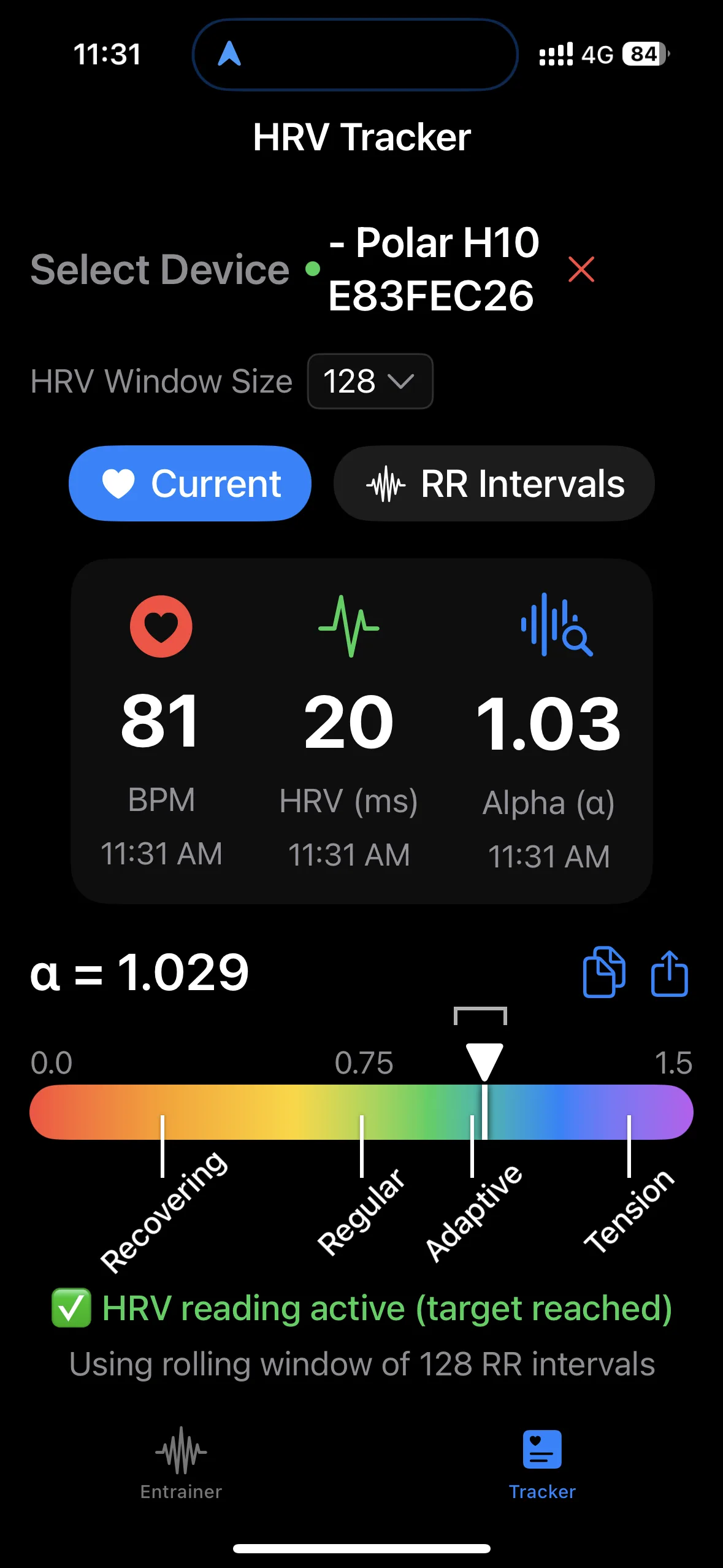
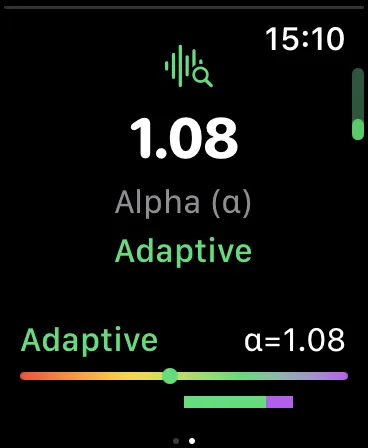
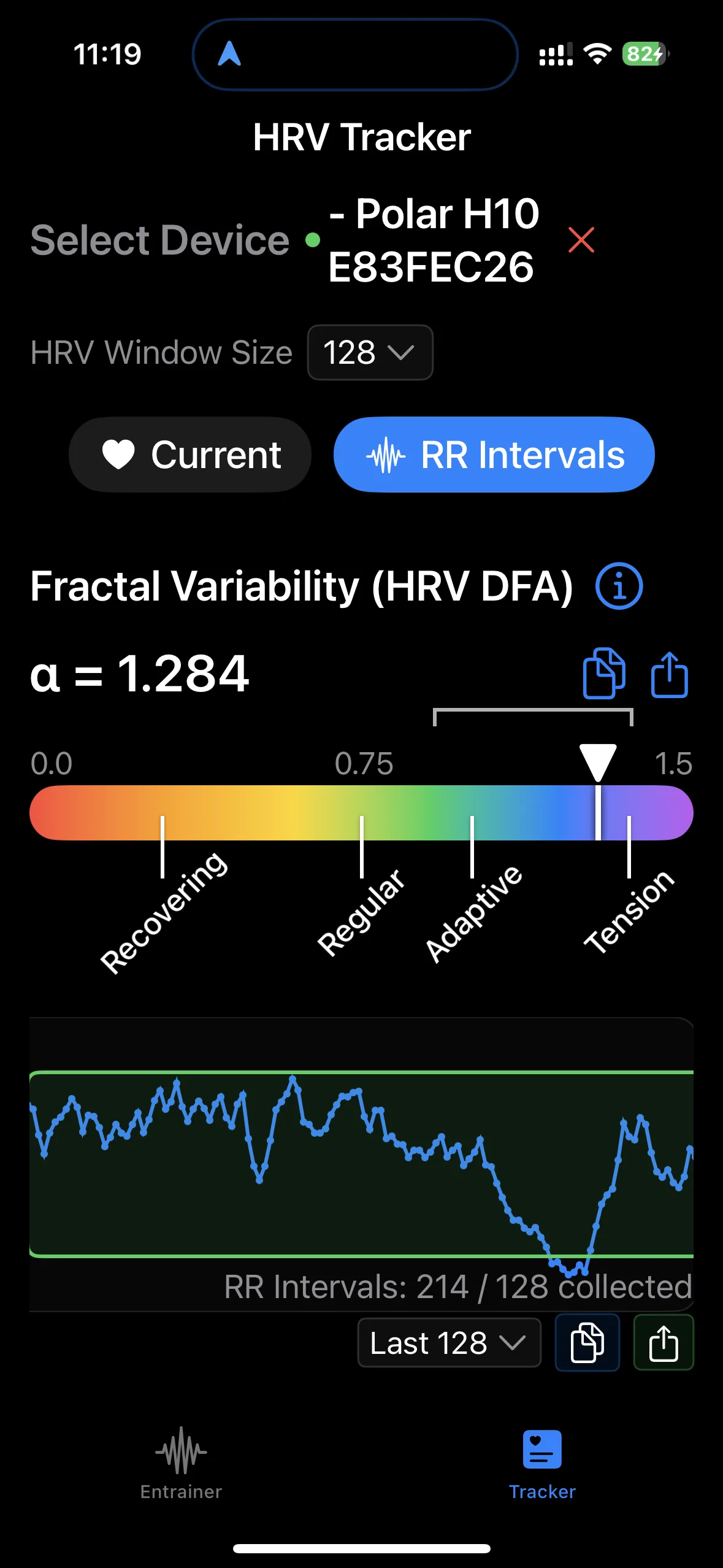
SelfSense pushes every interval into a rolling window and recomputes alpha1 as new beats arrive. After about two minutes of recording the reading is meaningful, and it is placed on the scale above: recovering, regular, adaptive, or tension. The longer explanation is in Fractal Heart Rate Variability.
The common HRV numbers do not show this. RMSSD mostly reflects vagal, parasympathetic activity, so it says the body is at rest but little about how it handles activity. SDNN gives weight to slower outside influences. Alpha1 relates the two: when it is near 1, beat-to-beat fluctuations follow the same scaling as the longer ones, which means the regulatory loops are working together.
In practice the heart reading is used in three ways. The first is to find out when your own heart is at its most adaptive. For some people that is during sleep, for some during a particular kind of breathing, for others during rest. The second is to test a breathing pattern: absolute HRV may fall while you breathe, and what you look for is the pattern that brings alpha1 close to 1. The third is training. During exercise, ordinary HRV falls and stops being informative, while alpha1 keeps moving. A value around 0.75 has been shown to sit close to the aerobic threshold,5,6 though individual values scatter around that group average, which is why SelfSense lets you set your own threshold. A comparison with other tools that measure alpha1 is in Fractal HRV Apps.
The trainer for the heart is the entrainer, a bodymind metronome that guides breathing with a fractal rhythm in place of a fixed cadence, on screen, by sound, or by haptics on the Apple Watch. You measure with the tracker, breathe with the entrainer, and measure again. The reasoning is in Breathing for HRV, and the steps are in How to Use SelfSense.
Movement
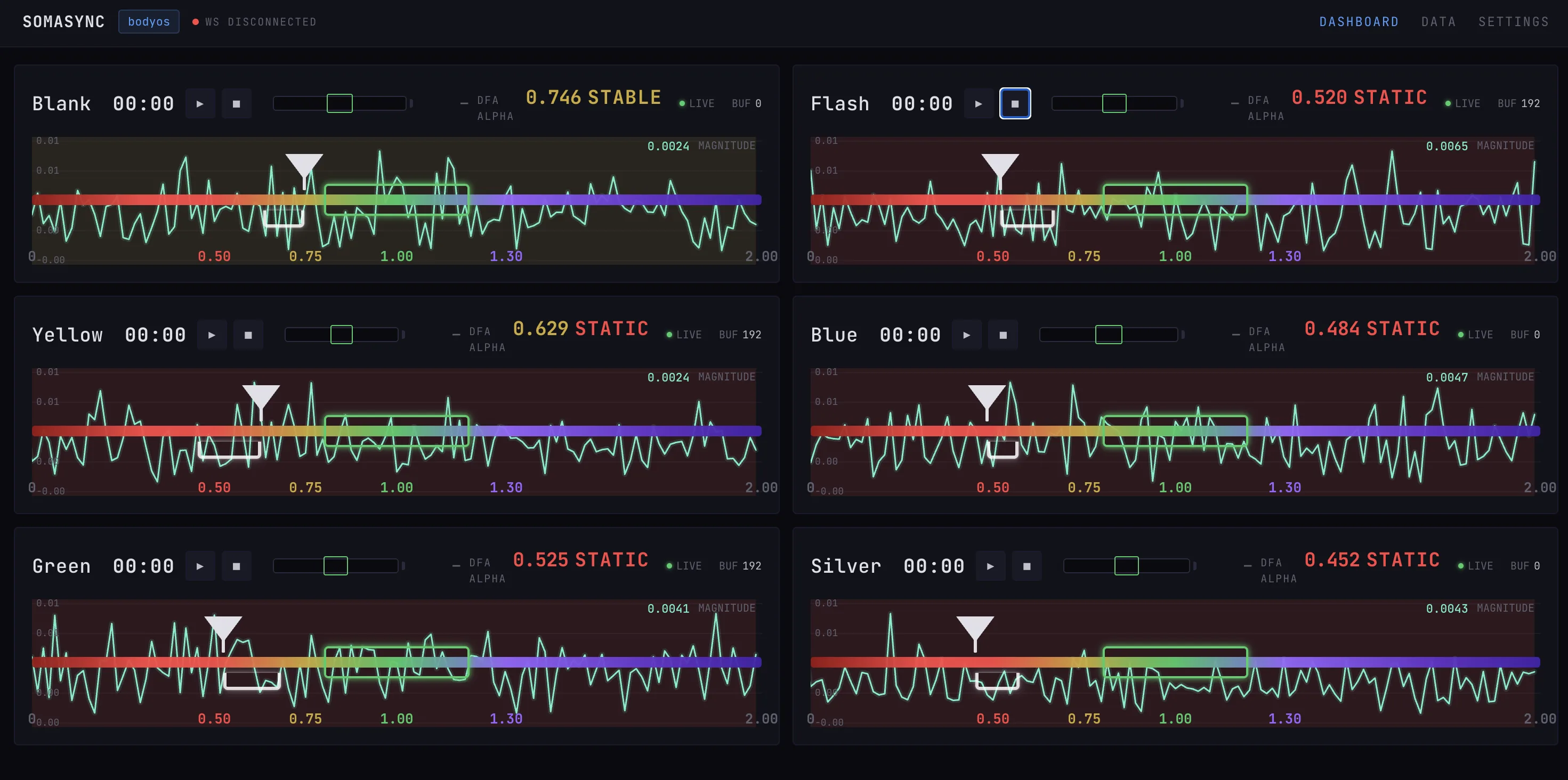
Taken off the chest strap and attached to a wrist, a hip, an ankle or the head, the same sensor becomes a movement sensor. It streams acceleration on three axes. SelfSense removes gravity, reduces the three axes to one number (the magnitude, √(x² + y² + z²)), and runs the same DFA over a rolling window of 128 samples, recomputed every 4 new samples. By default the SelfSense Server takes the sensor's 13 Hz stream and keeps every third sample, so one window covers about half a minute of movement and the reading updates about once a second. This is movement mode, described in Adaptive Movement Variability. It needs no steps, so it works for standing, postural work and improvised movement.
The research behind it goes back decades. Yamada showed in 1995 that the small sway of a person standing still is chaotic and not merely noisy.7 Hausdorff and colleagues found long-range, fractal correlations in the stride intervals of healthy walkers.8 Later work tied the loss of that structure to ageing, neurological disease and falls.9,10
Adaptive and resilient movement is something that operates at the widest range of possibilities. It can be small and big, it can be slow and fast. Your body is a receiver, a radio, and it's listening to all the different frequencies and is ready to respond to all of them.
From the SelfSense adaptive movement video
What this means for the person moving is easier to feel than to describe. In the video the sensor is on the wrist and the app shows a small triangle travelling along the spectrum. Repeating a movement puts it in the yellow zone the app calls Stable: you can predict what comes next, so the body is locked into a pattern. Repeating more takes it into the red. Forcing the change takes it the other way, into the indigo zone called Driven, where the mind is deciding how to move. The green zone, with alpha near 1, appears when the pattern keeps changing and the way it changes does not itself become a habit.
The practical instruction is to work with a few qualities (speed, amplitude, tension and relaxation) and to move between their extremes organically. Going from slow to fast, you introduce a few faster movements, then more, and once you are fast you look for slowness inside the fast movement. The fractal structure is visible if you compare time scales. Over forty seconds the movement went from small to big and from slow to fast. Split those forty seconds into ten parts of four seconds, and in each part the same kind of change is present at a smaller scale.
Gait
Walking gets its own mode. In gait mode SelfSense detects each heel strike from the vertical acceleration of a Movesense sensor (or of the Apple Watch or iPhone), and measures the time from one step to the next. That inter-step interval is the movement equivalent of an R-R interval, and the same DFA runs over a rolling window of 128 of them. With the sensor on the chest, a hip or an ankle, the reading follows that part of the body through the walk.
A healthy stride is never perfectly regular. Hausdorff and colleagues found that the small differences from one stride to the next are correlated over hundreds of steps,11 and that this structure stays stable across slow, normal and fast walking.8 It weakens when the system that produces it loses coordination: stride alpha was 0.87 in young adults against 0.68 in older adults, and 0.60 in people with Huntington's disease against 0.88 in healthy controls.12
This matters for training, because a fixed metronome flattens the stride. When people walked in time with one, their stride-interval series became uncorrelated: the walking looked more regular and the fractal structure was gone.8 A metronome whose beats follow a fractal pattern restored it.13 This is why the movement trainer in SelfSense is the same fractal metronome that guides breathing. You follow it through haptic pulses on the wrist and time your steps to them, for example two steps to each pulse, while the tracker shows where your alpha goes.
It can be hard to produce a fractal gait at first. Walking is one of the most automatic things the body does. Movement mode is the easier place to start, because it reacts at once to a shift of weight or a softer arm swing, and what you learn there can then be brought into the walk.
Two limits apply. The exponent used in gait research needs about 600 strides or more to be reliable,14 while SelfSense reports short-term alpha1 on a rolling window, so treat it as a trend within a session. And stride timing from wearables agrees best with laboratory equipment at sampling rates of 400 Hz and above,15 which is more than a watch or phone provides. The research, the practice and the limits are covered in full in Fractal Gait Variability.
From sensor to reading
- SensorMovesenseAcceleration at 13 Hz and up, or R-R intervals per beat
- RadioBluetooth LEGATT SensorData Protocol, a few metres of range
- Drivermovesense-driverNode.js; reconnects and resubscribes on its own
- AnalysisSelfSense ServerRolling window per sensor, DFA alpha1 and alpha2
- OutputDashboard, OSC, WebSocketLive state for viewers, sound and visual software
There are two ways for a Movesense to reach SelfSense. It can be paired with the iPhone app, next to an Apple Watch or a Polar H10. Or it can connect to the SelfSense Server, a desktop app that talks to several sensors at once, computes alpha for each, and broadcasts the result to a shared dashboard (the full reference is the Event Server guide). Bluetooth reaches only a few metres, so the server has to run on a laptop in the room.
The connection between the sensor and the server is movesense-driver, an open-source Node.js package. It speaks the sensor's own protocol directly and exposes each stream as an event:
const { MovesenseScanner } = require('movesense-driver');

const scanner = new MovesenseScanner();
const device = await scanner.findOne({ timeoutMs: 30000 });
await device.connect();

// movement: three-axis acceleration, in mg
device.on('acc', ({ samples }) => { /* [{x, y, z}, ...] */ });
await device.subscribeAcc(13);

// heart: R-R intervals, in ms
device.on('rr', (intervals) => { /* [812, 797, ...] */ });
await device.subscribeHr();
A sensor that drops out is reconnected and its streams are resubscribed without anyone touching it, which matters when it is strapped to a dancer in the middle of a session. Every session can be recorded with raw values, computed alpha and timestamps for later analysis.
Several sensors, several bodies
One sensor tells you about one rhythm. Several tell you about their relation. With sensors on the head, wrist, hips and legs, the whole body moves with feedback, and you can see which parts are stuck, which are repetitive, and which are changing too much. A dancer can wear three Movesense sensors and a heart stream, all visible on one dashboard. A workshop can run ten participants from a single laptop.
The server also sends the readings out over OSC, so the state of a body can drive sound or light in software such as Usine, ORCA, Max or TouchDesigner. This follows from fractal choreography, a practice first built with purpose-made sensors, in which the music plays only while the body moves fractally. Rigid movement and chaotic movement both leave it silent.
A reminder, not a target
There is a possible toxic aspect. Once a person sees their own variability rendered back in real time, the number becomes a target, and a target is one more pattern to get stuck in. SelfSense began as a somatic practice that took this as its subject: a measurement shown back to the person measured changes what that person does.
The adaptive state is also not a place to stay permanently. Each end of the scale has its use, and the skill is in moving between the states on demand.
In the video the role of the sensor is stated plainly: it is there to remind you occasionally to change pattern. The more time you spend in the green zone, the less you need to look, and eventually it is better to close your eyes and move. The heart is then, in the words of the practice, an inspiration to listen to and not a metric to optimise.
Technology that helps you notice yourself more carefully, not technology that tells you what to do.
About the SelfSense practice
References
Papers
- Peng, C.-K., Havlin, S., Stanley, H. E., & Goldberger, A. L. (1995). Quantification of scaling exponents and crossover phenomena in nonstationary heartbeat time series. Chaos, 5(1), 82–87. doi:10.1063/1.166141
- Hardstone, R., Poil, S.-S., Schiavone, G., Jansen, R., Nikulin, V. V., Mansvelder, H. D., & Linkenkaer-Hansen, K. (2012). Detrended fluctuation analysis: a scale-free view on neuronal oscillations. Frontiers in Physiology, 3, 450. doi:10.3389/fphys.2012.00450
- Goldberger, A. L., Amaral, L. A. N., Hausdorff, J. M., Ivanov, P. Ch., Peng, C.-K., & Stanley, H. E. (2002). Fractal dynamics in physiology: alterations with disease and aging. PNAS, 99(suppl. 1), 2466–2472. doi:10.1073/pnas.012579499
- Rogers, B., Schaffarczyk, M., Clauß, M., Mourot, L., & Gronwald, T. (2022). The Movesense Medical Sensor chest belt device as single channel ECG for RR interval detection and HRV analysis during resting state and incremental exercise: a cross-sectional validation study. Sensors, 22(5), 2032. doi:10.3390/s22052032
- Gronwald, T., Rogers, B., & Hoos, O. (2020). Fractal correlation properties of heart rate variability: a new biomarker for intensity distribution in endurance exercise and training prescription? Frontiers in Physiology, 11, 550572. doi:10.3389/fphys.2020.550572
- Rogers, B., Giles, D., Draper, N., Hoos, O., & Gronwald, T. (2021). A new detection method defining the aerobic threshold for endurance exercise and training prescription based on fractal correlation properties of heart rate variability. Frontiers in Physiology, 11, 596567. doi:10.3389/fphys.2020.596567
- Yamada, N. (1995). Chaotic swaying of the upright posture. Human Movement Science, 14(6), 711–726. doi:10.1016/0167-9457(95)00032-1
- Hausdorff, J. M., Purdon, P. L., Peng, C.-K., Ladin, Z., Wei, J. Y., & Goldberger, A. L. (1996). Fractal dynamics of human gait: stability of long-range correlations in stride interval fluctuations. Journal of Applied Physiology, 80(5), 1448–1457. doi:10.1152/jappl.1996.80.5.1448
- Stergiou, N., & Decker, L. M. (2011). Human movement variability, nonlinear dynamics, and pathology: is there a connection? Human Movement Science, 30(5), 869–888. doi:10.1016/j.humov.2011.06.002
- Terrier, P., & Piergiovanni, S. (2026). An accelerometry-based marker of gait automaticity is lower in older adults reporting recent falls. Gait & Posture, 128, 110205. doi:10.1016/j.gaitpost.2026.110205
- Hausdorff, J. M., Peng, C.-K., Ladin, Z., Wei, J. Y., & Goldberger, A. L. (1995). Is walking a random walk? Evidence for long-range correlations in stride interval of human gait. Journal of Applied Physiology, 78(1), 349–358. doi:10.1152/jappl.1995.78.1.349
- Hausdorff, J. M., Mitchell, S. L., Firtion, R., Peng, C.-K., Cudkowicz, M. E., Wei, J. Y., & Goldberger, A. L. (1997). Altered fractal dynamics of gait: reduced stride-interval correlations with aging and Huntington's disease. Journal of Applied Physiology, 82(1), 262–269. doi:10.1152/jappl.1997.82.1.262
- Marmelat, V., Torre, K., Beek, P. J., & Daffertshofer, A. (2014). Persistent fluctuations in stride intervals under fractal auditory stimulation. PLoS ONE, 9(3), e91949. doi:10.1371/journal.pone.0091949
- Damouras, S., Chang, M. D., Sejdić, E., & Chau, T. (2010). An empirical examination of detrended fluctuation analysis for gait data. Gait & Posture, 31(3), 336–340. doi:10.1016/j.gaitpost.2009.12.002
- Jones, B. D. M., Wheat, J., Middleton, K., Carey, D. L., & Heller, B. (2026). Agreement and reliability of running stride-time variability analyses from wearable devices. Sensors, 26(11), 3407. doi:10.3390/s26113407
Related pages on selfsense.me
- What Is the SelfSense App? — The trackers and trainers in one overview.
- How SelfSense Works — The science behind the fractal approach.
- How to Use SelfSense — Connecting a sensor and running a session.
- Fractal Heart Rate Variability & DFA Alpha — The heart side of the measure.
- Adaptive Movement Variability — Movement mode and the three states.
- Fractal Gait Variability — Gait research, the fractal metronome and its limits.
- Adaptive Variability — Why the body needs conversation across scales.
- Breathing for HRV — Which breathing keeps multi-scale structure.
- Nervous System Regulation — How chronic stress shows up as lost complexity.
- Fractal HRV Apps — SelfSense among other tools that measure alpha1.
- The SelfSense Server and the Event Server guide — Multi-sensor and group sessions.
- Fractal Choreography — Sensors, dance and sound.
- About the SelfSense Practice and Heart as an Inspiration — Where the app comes from.
Other sources
- Paranyushkin, D. Chaotic Fractal Movement Variability. EightOS. 8os.io/chaotic-fractal-movement-variability
- Nodus Labs. movesense-driver, Node.js driver for Movesense BLE sensors. npmjs.com/package/movesense-driver